Cold-Weather Concrete Pours
Concrete poured to ACI 306 cold-weather protocol — the difference between a slab that survives its first Flagstaff winter and one that doesn't.
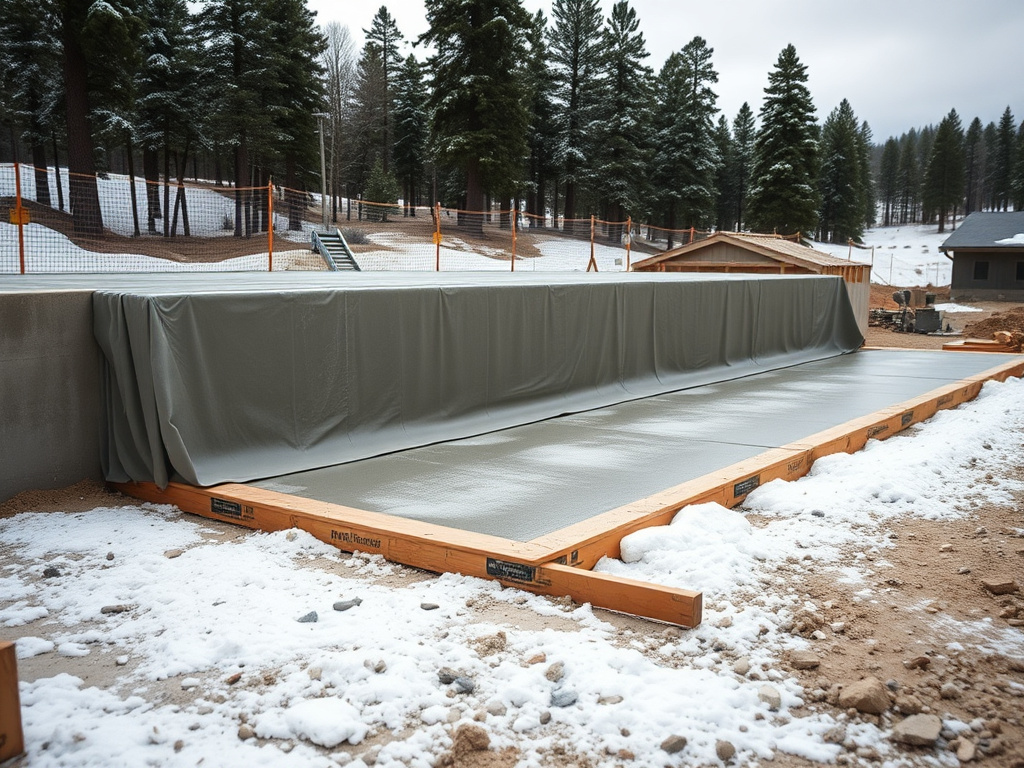
Almost everywhere else in Arizona, "cold-weather concreting" isn't a real consideration. Flagstaff and the rest of Northern Arizona are the exception — with roughly 206 days a year at or below 32°F and a reliable pour season that runs closer to June through September, a meaningful share of the concrete work in this region happens right at the edge of, or outside, ideal pouring conditions. We don't treat that as an obstacle to work around; it's a specialty we build every project plan on when the calendar calls for it.
ACI 306, the industry standard for cold-weather concreting, kicks in whenever the air temperature is at or expected to fall below 40°F during the protection period. Getting a pour right under those conditions is entirely achievable — it just requires a different playbook than a warm-weather pour, and skipping that playbook is exactly how driveways, patios, and foundations end up cracked or scaled after their first winter.
Why homeowners choose it
- Concrete placed at a minimum temperature around 55°F for slabs under 12 inches thick, per ACI 306 guidance
- Insulated curing blankets — R-4 rated for lows above 25°F, R-8 rated for colder conditions — protecting fresh pours immediately after finishing
- Accelerating admixtures or Type III cement specified when a faster strength-gain curve is needed
- In-place strength monitoring so protection isn't removed until the concrete has genuinely reached the roughly 500 psi threshold needed to survive its first freeze
- Realistic scheduling that plans around Northern Arizona's real winter calendar instead of ignoring it
What actually happens on a cold-weather pour
The core risk in cold-weather concreting is straightforward: fresh concrete that freezes before it reaches roughly 500 psi compressive strength can suffer permanent damage — reduced strength, surface scaling, and durability loss that shows up for years afterward. The whole point of cold-weather protocol is keeping the concrete warm enough, long enough, for it to get past that threshold before a hard freeze can reach it.
In practice, that means placing the concrete warm (generally at least 55°F for typical slab thicknesses), then covering it immediately with insulated curing blankets sized to the expected overnight low — heavier R-8 blankets when temperatures are dropping into the teens or below, lighter R-4 coverage when lows stay above 25°F. On some projects we'll specify an accelerating admixture or Type III cement to speed up the strength-gain curve, or bring in temporary heated enclosures for foundation work that can't wait for warmer weather. We also use in-place temperature and strength monitoring rather than guessing when it's safe to pull protection — removing blankets too early is one of the most common ways a cold-weather pour gets damaged after the fact.
- 40°F trigger threshold for full ACI 306 cold-weather protocol
- Insulated blanket coverage sized to the actual overnight low, not a flat default
- Accelerating admixtures or Type III cement when the schedule demands faster strength gain
- In-place monitoring instead of guesswork on when protection can come off
Planning around a short building season
With frost-free conditions realistically limited to a few months a year at Flagstaff's elevation, a lot of new-construction and homeowner projects here simply can't wait for a perfect summer window — builders have framing crews scheduled, homeowners have moving dates, and cabin owners in Payson or Munds Park often only have limited seasonal access to the property in the first place. Rather than treating a cold snap as a reason to delay, we build cold-weather protocol into the estimate and schedule from the start whenever a pour is likely to land in shoulder-season territory.
Ideal for
- Any driveway, patio, or foundation pour scheduled between fall and spring in Flagstaff, Williams, or Munds Park
- New-construction projects on a builder's timeline that can't simply wait for June
- Homeowners who've seen a previous pour crack or scale after a winter and want to understand what went wrong
- General contractors who need a concrete crew that already runs cold-weather protocol as standard practice, not an afterthought
What affects the cost
Cold-Weather Pours questions, answered
We don't have a hard cutoff — ACI 306 cold-weather protocol simply activates once air temperature is at or expected to fall below 40°F during the protection period, and we build the pour plan around that: warmer placement temperature, insulated blanket coverage sized to the overnight low, and in some cases accelerating admixtures or heated enclosures. Extremely severe conditions can push a pour to a different day, but a lot of what looks like "too cold to pour" weather is entirely workable with the right protocol.
Concrete needs to reach roughly 500 psi compressive strength before it can survive its first freeze cycle without damage. If it freezes before that, the ice crystals forming inside the still-wet mix can cause permanent strength loss, surface scaling, and reduced long-term durability — damage that's often visible for years afterward and generally isn't something you can fix after the fact. That's the exact failure mode cold-weather protocol — warm placement temperature, insulated curing, and strength monitoring — is designed to prevent.
Cold-Weather Pours poured right, by a crew that builds for this elevation
Cold-Weather Pours isn't a commodity — the result depends entirely on how carefully it's planned and poured for your specific site and Northern Arizona's real freeze-thaw climate. We evaluate what your project actually needs, prep the base and soil properly, and pour to an air-entrained, freeze-thaw-rated mix, so the work holds up the way it's supposed to.
We serve Flagstaff, Prescott, Prescott Valley, Sedona, Payson, Williams, and Munds Park. Every job starts with a free, no-pressure estimate.
Just as important, we plan every cold-weather pours project around the whole site, not just the slab itself — soil conditions, drainage, and the season the pour lands in all interact, and getting one right while ignoring the others is exactly how flatwork ends up cracked or heaved after a winter or two. When we scope your cold-weather pours, we look at how it fits the whole picture — so the finished result performs the way it should for decades of real Northern Arizona winters, not just the first one.
Free on-site estimate
We evaluate your site and soil, and give you a clear, itemized estimate.
Expert pour
We prep the base, place, and finish your cold-weather pours to spec — clean and on schedule.
Built for the long haul
Air-entrained, freeze-thaw-rated concrete and honest advice about what your project actually needs.
Related services
Ready for a free cold-weather pours estimate?
Tell us about your driveway, patio, or new-build project and we'll put together a clear, no-pressure estimate — poured and cured for Northern Arizona's real freeze-thaw climate.