New Concrete Driveways
A new driveway built for a mountain-town winter, not a desert one — proper base prep, air-entrained mix, and joint spacing sized for real freeze-thaw cycling.
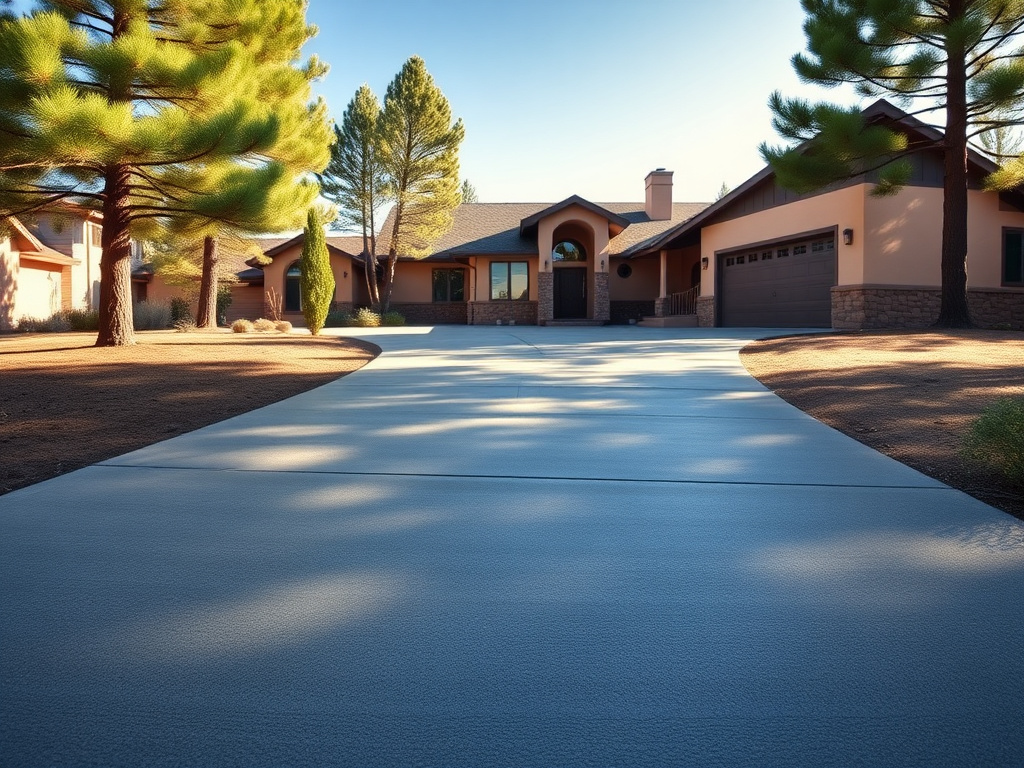
Most Arizona concrete advice is written for Phoenix and Tucson — hot, dry, and essentially frost-free. Flagstaff sits at roughly 6,909 feet and averages around 206 days a year at or below 32°F, with a growing season that typically runs only from early June to late September. That's a genuinely different climate, and a driveway poured the same way a desert contractor pours one won't hold up here the way it should.
A new concrete driveway in Northern Arizona needs three things a low-desert driveway doesn't have to worry about nearly as much: a properly compacted base that won't heave when it freezes, an air-entrained mix rated for freeze-thaw exposure, and control joints spaced to handle the stress of repeated freeze-thaw cycling rather than just shrinkage cracking. We build all three into every driveway we pour, whether it's a straightforward single-car pad or a long approach on a hillside lot outside Prescott.
Why homeowners choose it
- Air-entrained concrete mix (targeting the 5-7% air content range recommended for freeze-thaw-exposed exterior flatwork) instead of a standard desert mix
- Compacted gravel base — 6 inches under vehicle-load areas — engineered for drainage and frost-heave resistance, not just load-bearing
- Control joints spaced on the tighter end of standard ACI guidance (roughly 8-12 feet for a 4-inch slab) to control freeze-thaw stress cracking
- Broom, exposed-aggregate, or stamped finish options, sized and priced to your project
- Built to the same footing and frost-depth standards our foundation crews use, so approach slabs and attached footings tie together correctly
Why freeze-thaw changes how a driveway gets built
Water that gets into concrete — through the surface, through joints, or up from a saturated base — expands roughly 9% when it freezes. In a climate like Phoenix's, that's rarely an issue. In Flagstaff, where the ground swings above and below freezing dozens of times across the shoulder seasons, unprotected concrete can spall, scale, or crack at the surface over a few winters if it wasn't built for the exposure.
Air entrainment is the primary defense: it works microscopic air bubbles into the mix that give freezing water somewhere to expand into, relieving the internal pressure that would otherwise crack the concrete from the inside out. It's a mix-design decision made before the truck ever shows up, and it's one of the first things we specify differently from a desert-market pour.
- Air-entrained mix targeting 5-7% air content for exterior flatwork
- 6-inch compacted gravel base under drive lanes for drainage + frost resistance
- Joint spacing tightened for freeze-thaw stress, not just shrinkage control
- Grading and drainage planned so snowmelt sheds away from the slab, not under it
Base prep on Northern Arizona's mix of soils
Soil conditions shift dramatically across our service area, sometimes within the same lot. Around Flagstaff, you're often dealing with volcanic cinder and decomposed tuff from the San Francisco volcanic field — generally free-draining, but frozen cinder fill can slow winter excavation, and spring snowmelt can soften ground near washes. On Prescott's hillside lots in and around the Granite Dells, it's common to hit exposed granite bedrock in one spot and a pocket of deep, reactive expansive clay a few feet away on the same parcel.
That's why we don't quote base prep off a generic template. We look at your actual site, compact a gravel base sized for what's underneath it, and grade for drainage so water — whether it's monsoon rain or spring snowmelt — moves away from the slab instead of saturating the base and setting up a freeze-heave problem later.
Ideal for
- New-build homes that need a driveway poured as part of construction
- Replacing a gravel or asphalt approach with concrete
- Longer hillside driveways in Prescott, Sedona, or Payson that need real grading and drainage planning
- Homeowners who've seen a neighbor's driveway heave or crack from a freeze-thaw winter and want it done right the first time
What affects the cost
Driveways questions, answered
Nationally, a standard broom-finish driveway typically runs $8-$12 per square foot installed, with stamped or decorative finishes running $12-$18 per square foot. We haven't found a published Flagstaff-specific pricing study, and it's reasonable to expect regional pricing to land at or above the higher end of those national ranges given mountain-market material and fuel transport costs, the statewide construction labor shortage, and the added cost of cold-weather pour protocols during shoulder-season work. A free on-site estimate gets you a firm number for your project.
Yes, with the right protocol. ACI 306 cold-weather concreting guidance kicks in once air temperature is at or expected to fall below 40°F. That typically means placing concrete at a minimum temperature around 55°F for slabs under 12 inches thick, then protecting the fresh pour with insulated curing blankets — R-4 rated blankets for lows above 25°F, R-8 for colder — until it reaches roughly 500 psi, the strength threshold concrete needs before it can survive its first freeze cycle undamaged. Given Flagstaff's roughly 206 days a year at or below 32°F, a lot of driveway pours here happen under some version of this protocol.
Driveways poured right, by a crew that builds for this elevation
Driveways isn't a commodity — the result depends entirely on how carefully it's planned and poured for your specific site and Northern Arizona's real freeze-thaw climate. We evaluate what your project actually needs, prep the base and soil properly, and pour to an air-entrained, freeze-thaw-rated mix, so the work holds up the way it's supposed to.
We serve Flagstaff, Prescott, Prescott Valley, Sedona, Payson, Williams, and Munds Park. Every job starts with a free, no-pressure estimate.
Just as important, we plan every driveways project around the whole site, not just the slab itself — soil conditions, drainage, and the season the pour lands in all interact, and getting one right while ignoring the others is exactly how flatwork ends up cracked or heaved after a winter or two. When we scope your driveways, we look at how it fits the whole picture — so the finished result performs the way it should for decades of real Northern Arizona winters, not just the first one.
Free on-site estimate
We evaluate your site and soil, and give you a clear, itemized estimate.
Expert pour
We prep the base, place, and finish your driveways to spec — clean and on schedule.
Built for the long haul
Air-entrained, freeze-thaw-rated concrete and honest advice about what your project actually needs.
Related services
Ready for a free driveways estimate?
Tell us about your driveway, patio, or new-build project and we'll put together a clear, no-pressure estimate — poured and cured for Northern Arizona's real freeze-thaw climate.