Concrete Patios & Outdoor Living
A new outdoor living space poured for Northern Arizona's genuine four seasons — courtyards, fire-pit patios, and pine-shaded entertaining areas built to handle snow load and freeze-thaw, not just summer sun.
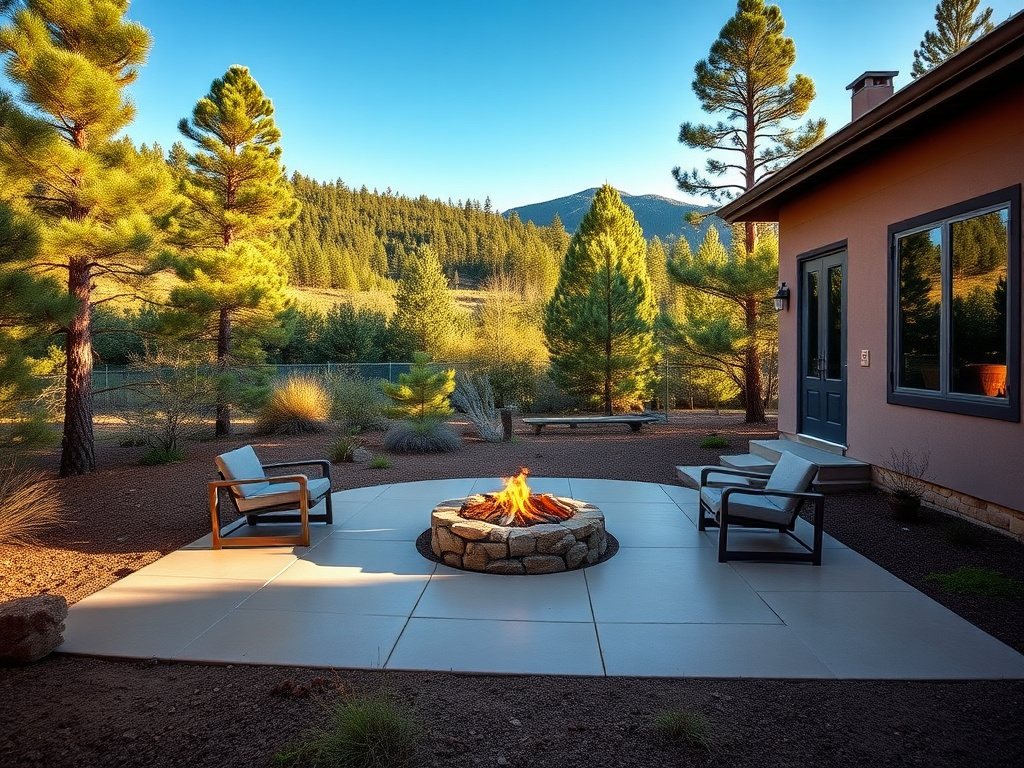
Northern Arizona's short, cool summers make outdoor living space genuinely valuable — Flagstaff's growing season runs roughly early June to late September, and homeowners here use their patios differently than a Phoenix homeowner chasing shade from 110°F heat. A new patio in this region needs to handle the opposite problem for most of the year: standing up to snow load, freeze-thaw cycling at the edges and joints, and the occasional heavy monsoon downpour, while still giving you a real outdoor room during the short window when the weather cooperates.
We pour patios sized and finished for how you'll actually use the space — fire-pit patios in a pine-shaded backyard, a courtyard entry that ties into a covered outdoor room, or a simple, clean slab off a walkout basement — with the same freeze-thaw-rated mix and base prep we use on every exterior pour in this region.
Why homeowners choose it
- Air-entrained concrete and properly compacted base sized for a real winter, not a desert one
- Grading and drainage planned around snowmelt and monsoon runoff, not just summer rain
- Broom, exposed-aggregate, or stamped/decorative finish options
- Joint layout planned around fire pits, planting beds, and structural elements like posts or pergola footings
- Sized and shaped to fit your actual outdoor living plans, not a generic rectangle
Planning around snow load and freeze-thaw at the edges
The most common failure point on a poorly built patio in a freeze-thaw climate isn't the middle of the slab — it's the edges, steps, and any spot where water can pool against the concrete and freeze. We grade every patio to shed water away from the slab and any adjoining structure, and we pay particular attention to transitions like steps and thresholds, where repeated freezing and thawing does the most damage over time if it isn't planned for at the design stage.
If your patio sits under a roofline or near a structure, we also account for snow shed and drift patterns — Flagstaff's city design snow load runs around 40 psf, with unincorporated Coconino County areas often higher, and while that's primarily a structural-engineering consideration for anything attached to the house, it's part of how we think about grading and edge detailing on patios that sit close to a building.
- Positive drainage grading away from the slab and any adjoining structure
- Reinforced or thickened edges at steps and thresholds where freeze-thaw stress concentrates
- Control joints planned around fire pits, footings, and planting beds
- Finish and sealer selection matched to sun/shade exposure under Northern Arizona's pine canopy
A patio that fits the property, not a template
Northern Arizona properties vary enormously — a flat, open lot in Prescott Valley calls for a different patio plan than a shaded, tree-lined lot in Flagstaff's Mt. Elden Foothills, or a red-rock-view lot in Sedona's Chapel area. We walk the site with you, talk through how you'll actually use the space, and design the patio's shape, size, and finish around that — not a one-size-fits-all rectangle.
Ideal for
- New-construction homes that need a patio poured as part of the build
- Homeowners adding a fire-pit patio or courtyard to an existing backyard
- Cabin and second-home owners in Payson, Munds Park, or Williams building out a simple, durable outdoor space
- Replacing an aging or heaving paver patio with a single continuous slab
What affects the cost
Patios questions, answered
A properly built ground-level patio slab isn't a structural snow-load concern the way a roof is — the ground supports it directly. What matters more is drainage and edge detailing so meltwater doesn't pool against the slab and drive freeze-thaw damage at the joints and edges over time. If your patio ties into a covered structure like a pergola or ramada, that structure's footings and framing do need to account for regional snow-load requirements, which is something we plan for at the design stage.
Shaded patios under a pine canopy hold moisture longer and can stay damp or icy longer after a storm, so we often recommend a broom finish or a lightly textured stamped pattern for slip resistance, paired with a sealer program suited to lower sun exposure. A smooth, heavily polished finish that looks great in full sun can become a slip hazard in a shaded, snow-prone spot.
Patios poured right, by a crew that builds for this elevation
Patios isn't a commodity — the result depends entirely on how carefully it's planned and poured for your specific site and Northern Arizona's real freeze-thaw climate. We evaluate what your project actually needs, prep the base and soil properly, and pour to an air-entrained, freeze-thaw-rated mix, so the work holds up the way it's supposed to.
We serve Flagstaff, Prescott, Prescott Valley, Sedona, Payson, Williams, and Munds Park. Every job starts with a free, no-pressure estimate.
Just as important, we plan every patios project around the whole site, not just the slab itself — soil conditions, drainage, and the season the pour lands in all interact, and getting one right while ignoring the others is exactly how flatwork ends up cracked or heaved after a winter or two. When we scope your patios, we look at how it fits the whole picture — so the finished result performs the way it should for decades of real Northern Arizona winters, not just the first one.
Free on-site estimate
We evaluate your site and soil, and give you a clear, itemized estimate.
Expert pour
We prep the base, place, and finish your patios to spec — clean and on schedule.
Built for the long haul
Air-entrained, freeze-thaw-rated concrete and honest advice about what your project actually needs.
Related services
Ready for a free patios estimate?
Tell us about your driveway, patio, or new-build project and we'll put together a clear, no-pressure estimate — poured and cured for Northern Arizona's real freeze-thaw climate.