Pouring Concrete at 7,000 Feet: What Cold-Weather Curing Actually Involves
Most concrete advice written for Arizona assumes a climate where freezing simply isn't a factor. That assumption falls apart the moment you're working at Flagstaff's elevation. NOAA climate normals put Flagstaff's average annual temperature at 45°F, with roughly 206 days a year at or below 32°F — a genuine freeze-thaw climate that behaves nothing like Phoenix or Tucson, and one that demands a real cold-weather concreting protocol for a meaningful share of the calendar year.
Winters here don't read as one long deep freeze so much as a repeating pattern — a stretch of several gentle, pleasant days followed by very cold nights, over and over through the season. That freeze-thaw cycling is exactly why concrete built for this climate needs to be planned differently from the ground up, not just protected from a single hard freeze.
Why freezing concrete is a real problem, not a minor inconvenience
Fresh concrete is mostly water in its early hours, and water expands roughly 9% when it freezes. If that expansion happens inside concrete that hasn't yet gained enough strength to resist it, the ice crystals forming inside the mix can cause permanent damage — reduced compressive strength, surface scaling, and durability loss that often doesn't show up as visible cracking until months or years later, well after the contractor who poured it has moved on.
The industry threshold that matters here is roughly 500 psi compressive strength — the point at which concrete has generally gained enough strength to survive its first freeze cycle without lasting damage. Cold-weather concreting protocol exists almost entirely to get fresh concrete past that threshold before a hard freeze can reach it.
The ACI 306 threshold: 40°F
ACI 306, the concrete industry's cold-weather concreting standard, defines cold-weather conditions as any period when the air temperature is at or expected to fall below 40°F during what's called the protection period — generally the first one to four days after placement, depending on the mix design and any accelerating admixtures used. Once that threshold is in play, several things change about how a pour gets planned and executed.
Placement temperature
Concrete should generally be placed at a minimum temperature around 55°F for sections under 12 inches thick — colder placement temperatures slow the hydration reaction that builds strength, extending the window during which the concrete is vulnerable to freeze damage. This can mean adjusting the mix design, the timing of the pour within the day, or both.
Insulated curing protection
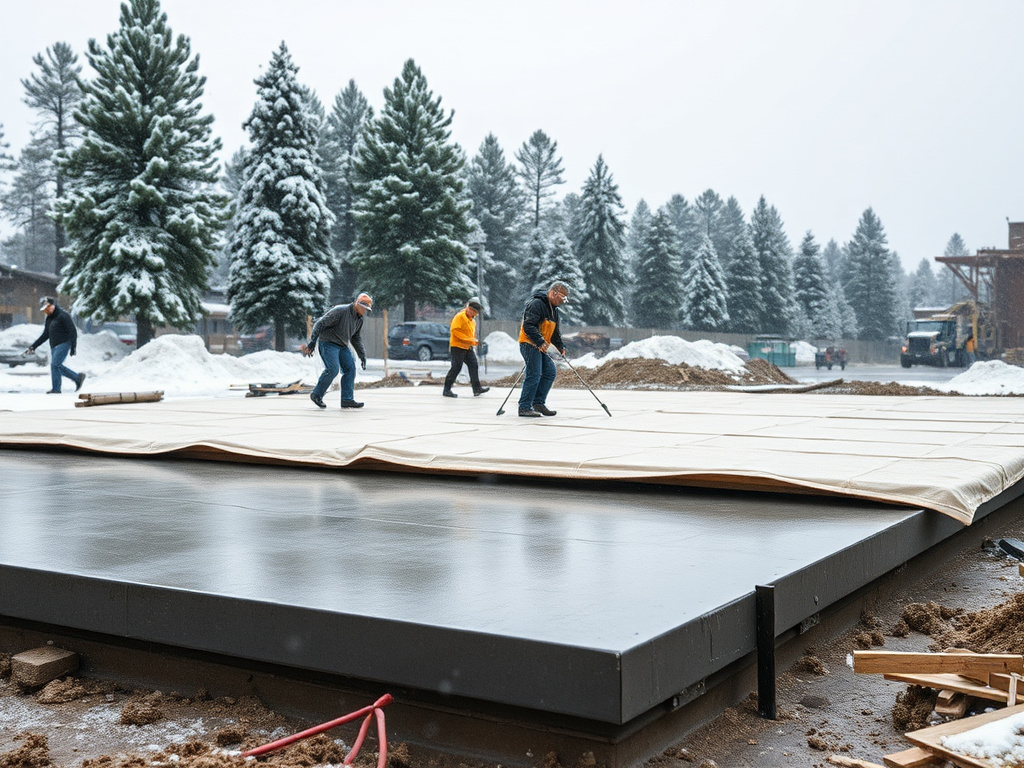
Immediately after finishing, cold-weather pours get covered with insulated curing blankets rated to the expected overnight low — R-4 rated blankets for lows staying above 25°F, and heavier R-8 rated coverage when temperatures are expected to drop further. This isn't optional in genuinely cold conditions; it's the primary line of defense keeping the concrete's internal temperature high enough to keep gaining strength overnight, when ambient temperatures typically drop the most.
Accelerating admixtures and Type III cement
On tighter schedules, an accelerating admixture or Type III cement can speed up the strength-gain curve, shortening the window during which the concrete needs active protection. This is a judgment call made based on the specific temperature forecast and project timeline, not a default for every cold-weather pour — sometimes a well-insulated blanket schedule is enough on its own.
Ground and enclosure heating
For foundation work or larger pours happening in harder freezes, temporary heated enclosures or ground-thaw equipment can be brought in to maintain a workable environment around the pour. This adds cost and complexity, which is part of why we plan the likely need for it into a project estimate up front rather than treating it as a surprise mid-project.
Knowing when it's actually safe to remove protection
One of the most common ways a cold-weather pour gets damaged isn't the initial placement — it's pulling insulation or protection too early, before the concrete has genuinely reached a safe strength. In-place temperature and strength monitoring takes the guesswork out of that decision, rather than relying on a fixed number of days that may or may not match what actually happened on site given a particular week's weather.
Air entrainment: the other half of freeze-thaw durability
Cold-weather protocol protects concrete during its first freeze, while it's curing. Air entrainment protects it for every winter after that, for the life of the slab. Air-entrained concrete has microscopic air bubbles worked into the mix, giving water inside the cured concrete somewhere to expand into when it freezes on any given winter day — instead of cracking the concrete from the inside out.
Industry guidance generally targets 5-7% air content for exterior flatwork exposed to repeated freeze-thaw cycling, with anything under roughly 4% considered inadequate for real durability in this kind of climate. This is a mix-design decision made before the concrete truck ever arrives on site, and it's one of the clearest, most consequential differences between a driveway built for Flagstaff and one built with a standard desert-Arizona mix that never has to account for a hard freeze.
Control joints matter more here too
Standard industry guidance calls for control joints spaced at roughly 24-36 times the slab thickness — about 8-12 feet apart for a typical 4-inch residential slab. In freeze-thaw climates, tighter spacing toward the lower end of that range is generally recommended, because freeze-thaw stress adds to the forces already working to crack a slab, and unsealed joints let water infiltrate and then freeze and expand inside the joint itself, accelerating spalling at the joint edges over time. Sealing joints properly after cutting is a small step that pays off specifically in this climate.
What this means if you're planning a project
If you're planning a driveway, patio, or foundation pour anywhere in Flagstaff, Williams, or Munds Park, there's a real chance at least part of your project timeline will fall into cold-weather territory — the average growing season here runs only about 103 days, with the average last spring freeze around May 28 and the first fall freeze around October 5. Rather than treating a cold snap as a reason to delay or rush a pour without proper protection, we build cold-weather protocol into the plan from the estimate stage whenever the calendar calls for it, so your project timeline stays realistic and your concrete doesn't pay the price for it later.
Frequently asked questions
It's workable with the right protocol — ACI 306 cold-weather concreting guidance covers exactly this situation. It's not safe to pour and simply walk away in freezing conditions without protection; concrete that freezes before reaching roughly 500 psi strength can suffer permanent damage.
It depends on the mix design, admixtures used, and actual temperatures, which is why we use in-place monitoring rather than a fixed schedule — protection stays on until the concrete has genuinely reached a strength safe from freeze damage, not just a default number of days.
Ready for a free quote?
Tell us about your home and we'll build a clear, no-pressure quote.